
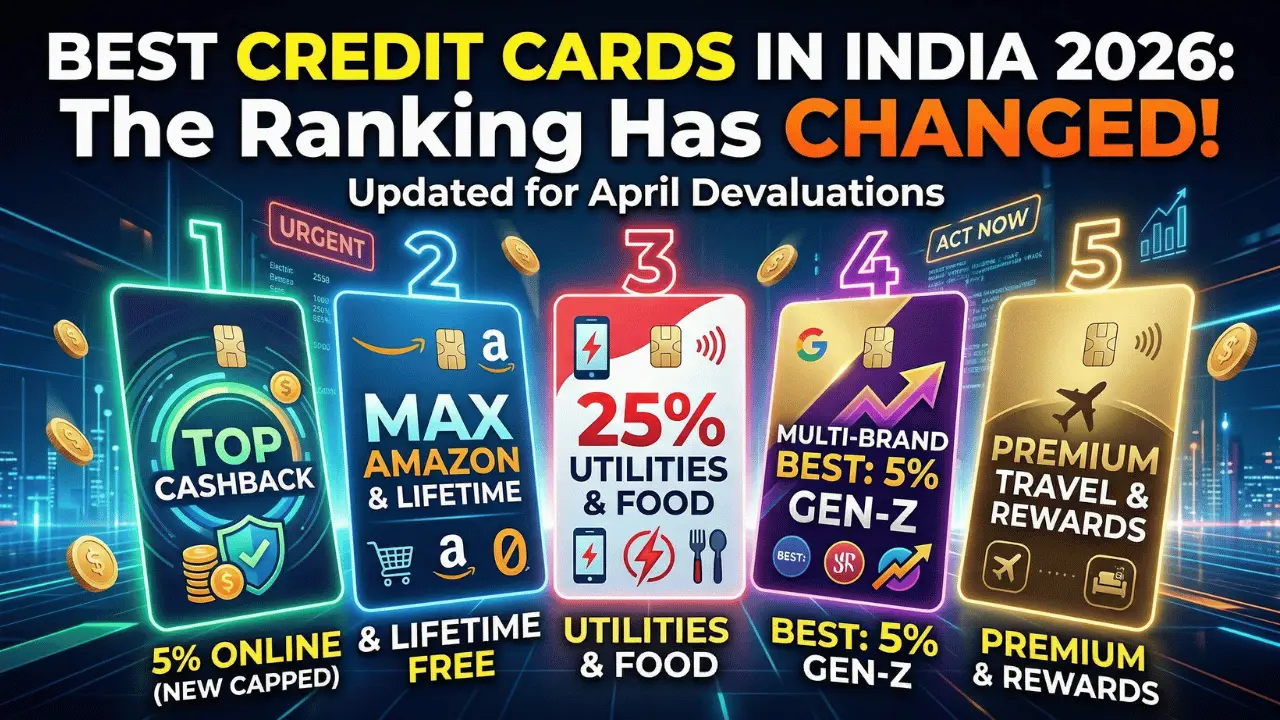
There is a quiet financial revolution happening in Indian wallets right now, and most people are leaving serious money on the table by carrying the wrong card. The best credit cards in India today are not just payment tools anymore — they are cashback engines, reward multipliers, and lifestyle companions built specifically for how Indians actually spend. Whether you are splitting a Swiggy order, paying your Airtel broadband bill, or filling a cart on Amazon at midnight, the right card can silently earn you thousands of rupees back every single month.
But with April 2026 bringing some of the most significant card devaluations in recent memory, knowing which card is truly worth carrying right now is more important than ever.
Why 2026 Is a Turning Point for Credit Card Rewards in India
The Indian credit card industry has matured dramatically over the past few years. Issuers are no longer throwing unlimited cashback at every category just to acquire customers. April 1, 2026 marked a clear inflection point — SBI restructured one of its most popular cards, Axis Bank quietly removed a travel benefit from another, and ICICI introduced new fees on international usage.
What worked brilliantly in 2025 needs a fresh look right now. The cards that still make sense after these changes are the ones worth understanding deeply, and that is exactly what this guide covers.
Overview: The Top Cards Still Worth Carrying After April 2026
The Indian market has always been rich with co-branded and category-specific credit card options, but only a handful consistently deliver enough real-world value to justify carrying them. After filtering for post-devaluation accuracy, six cards stand out as the strongest choices across different spending profiles — the SBI Cashback Card, Amazon Pay ICICI, Airtel Axis Bank, HDFC Millennia, HSBC Live+, and HDFC Regalia Gold.
Each one dominates a specific niche, and understanding which niche matches your actual spending habits is the whole game.
Best Credit Cards in India: Card-by-Card Breakdown
1. SBI Cashback Credit Card: Best for Capped Online Spending
Despite a meaningful devaluation effective April 1, 2026, the SBI Cashback Credit Card remains one of the strongest everyday cards for online shoppers who do not want to track rotating categories or brand-specific partnerships. The 5% cashback on most online transactions is still a genuinely powerful rate — almost no other card in India offers a flat percentage this high across all online platforms without restricting it to a specific retailer or app.
The key change to understand is that the cap has moved down sharply. The monthly cashback ceiling is now set at ₹2,000 per statement cycle, which means the card performs optimally when your total online spending stays under ₹40,000 a month. Heavy spenders beyond that threshold will hit diminishing returns, but for the majority of urban consumers, that ceiling is perfectly workable. The card also earns 1% cashback on offline transactions, keeping it useful when you pay in person.
One important update that SBI finalized in April 2026 is worth noting clearly: cashback does not apply to rent, utilities, fuel, government transactions, or digital gaming platforms. The annual fee sits at ₹999, waived on cumulative annual spends of ₹2 lakhs — a threshold most regular users clear comfortably within six to eight months.
2. Amazon Pay ICICI Credit Card: Best Lifetime Free Card
This card continues to be the single best no-annual-fee credit card in India, and nothing that happened in early 2026 changed that core value proposition. Amazon Prime members earn 5% unlimited cashback on all purchases made on Amazon India, with no monthly cap constraining those returns. Non-Prime users still earn a solid 3%, which is higher than what most restricted-category cards offer.
The partnership network extending 2% cashback to over 100 Amazon Pay partner merchants — including Swiggy and Uber — adds meaningful everyday utility beyond the Amazon platform itself.
The update worth flagging for international travelers is that ICICI Bank introduced a 1.99% Dynamic Currency Conversion fee for foreign transactions on this card earlier in 2026. For purely domestic users, this changes nothing. For frequent international travelers, it is a reason to carry a separate card for foreign spends. The zero joining and zero annual fee structure still makes this the easiest card to recommend to anyone building their credit history or looking for a zero-maintenance supplementary card.
3. Airtel Axis Bank Credit Card: Best for Utility and Food Delivery
This card has always been built around a very specific use case, and the April 2026 restructuring actually clarifies its identity rather than diminishing it. The 25% cashback on Airtel mobile recharges, broadband bills, and DTH payments via the Airtel Thanks app remains its headline feature — and for households running multiple Airtel connections, that alone can recover the entire annual fee within the first two or three billing cycles.
The 10% cashback on Swiggy, Zomato, and BigBasket adds another strong layer of monthly returns for anyone ordering food or groceries regularly through these platforms.
What Axis Bank removed in April 2026 is the complimentary airport lounge access that previously came with the card. This makes the positioning much cleaner — the Airtel Axis Bank card is now strictly a utility and food card, not a hybrid travel card. If you were carrying it partly for lounge access, you will need a separate card for that going forward. The annual fee is ₹500, waived on annual spends of ₹2 lakhs, making it one of the cheapest high-cashback cards on the market.
4. HDFC Millennia Credit Card: Best for Multi-Platform Spenders
The HDFC Millennia sits in a smart middle ground between a flat-cashback card and a co-branded card. Instead of tying your rewards to a single brand, it spreads 5% cashback across a broad ecosystem of platforms that define how most urban Indians in their twenties and thirties actually spend — Amazon, Flipkart, Myntra, Swiggy, Zomato, Uber, BookMyShow, and Cult.fit are all covered at that rate.
Rewards are credited as CashPoints that are straightforward to redeem, and all other online and offline spends earn 1% cashback, keeping the card productive even outside the primary partner list.
The annual fee is ₹1,000, waived on spends of ₹1 lakh per year — the lowest spend waiver threshold among the cards in this guide. That makes it a genuinely accessible option even for moderate spenders who want multi-brand coverage without locking themselves into a single platform.
5. HSBC Live+ Credit Card: Best for Dining and Groceries
HSBC has built something genuinely differentiated with the Live+ card, targeting the spending category that is simultaneously the largest and most underserved in Indian credit card rewards: food. The 10% cashback rate on dining, food delivery apps, and grocery purchases is the highest category-specific rate available on any mainstream card in India right now.
For a household spending ₹15,000 to ₹20,000 a month between restaurant bills, Swiggy or Zomato orders, and supermarket runs, that 10% translates to ₹1,500 to ₹2,000 in monthly savings — enough to justify the ₹999 annual fee in the very first month.
The 1.5% unlimited cashback on all other everyday expenses adds a second layer of value that keeps the card productive even on non-food spending. The annual fee waiver kicks in at ₹2 lakhs of annual spend. If food and groceries define your monthly budget more than any other category, this card is arguably the sharpest tool available in 2026.
6. HDFC Regalia Gold Credit Card: Best for Travel and Premium Lifestyle
The Regalia Gold operates on a fundamentally different philosophy from the cashback cards above — it is built around accumulating reward points and converting them into travel and lifestyle benefits rather than direct statement credits. The base earn rate of 4 Reward Points per ₹150 spent on retail purchases is solid, and the 5X acceleration on brands like Myntra, Nykaa, and Marks & Spencer makes it especially rewarding for premium lifestyle and fashion spending.
The travel benefits are what genuinely separate this card from its peers. Complimentary domestic and international airport lounge access is a tangible quality-of-life upgrade for anyone who travels with any regularity, and the milestone flight vouchers add further value once you cross certain annual spend thresholds.
At ₹2,500 per year, it is the most expensive card in this guide, but the waiver threshold is ₹3 lakhs — a number most regular Regalia Gold users clear naturally. For a consumer who books flights multiple times a year and values lounge comfort, this card pays for itself decisively.
How to Pick the Right Card From This List
The selection process is simpler than most comparison articles make it sound. Pull up your last three months of bank statements and identify where most of your money actually goes, not where you think it goes. If the biggest line items are online purchases across a mix of platforms, the SBI Cashback Card or HDFC Millennia are your strongest options. If food, groceries, and delivery apps dominate your spending, the HSBC Live+ will outperform everything else in this list.
If utility bills make up a significant fixed monthly expense and your household runs on Airtel services, the Airtel Axis Bank card will recover its fee faster than any other card here. If you travel frequently and want lounge access with reward-based redemptions, the HDFC Regalia Gold is the card built for your lifestyle. And if you shop heavily on Amazon and want zero fees with no strings attached, the Amazon Pay ICICI card has no real competition at the lifetime-free tier.
One principle worth internalizing after the April 2026 changes: read the exclusions before you swipe. Several cards that looked like universal cashback tools have now tightened their category lists meaningfully. The best credit cards in India are still genuinely excellent — they just reward you most when you understand their boundaries.
The Smart Way to Use Multiple Cards Together
The most financially optimized approach is rarely a single card. A simple two-card setup — one flat-cashback or multi-brand card for general spending, paired with a deep-category card for your primary expense bucket — captures the best of both worlds. Pairing the Amazon Pay ICICI card with the HSBC Live+ covers most of a typical household’s monthly spending at strong rates with minimal annual fee commitment.
Adding the Airtel Axis Bank card if your household runs on Airtel services creates a third layer of utility bill savings that essentially funds itself. The key is keeping the stack simple — two or three focused cards outperform six cards managed carelessly.
Conclusion
The best credit cards in India in 2026 are still genuinely rewarding, even after the April devaluations. The SBI Cashback Card, Amazon Pay ICICI, Airtel Axis Bank, HDFC Millennia, HSBC Live+, and HDFC Regalia Gold each represent the top of their respective categories — and for the right spending profile, any one of them can generate thousands of rupees in annual savings with zero extra effort.
The shift that April 2026 demands is simply more careful reading: caps have tightened, exclusions have expanded, and a few travel benefits have quietly disappeared. Choose the card that matches where your money already goes, stay aware of the updated limits, and the best credit cards in India will do exactly what they promise.
Which of these cards best matches your current spending habits — and are there any specific expense categories you wish more cards would cover?