
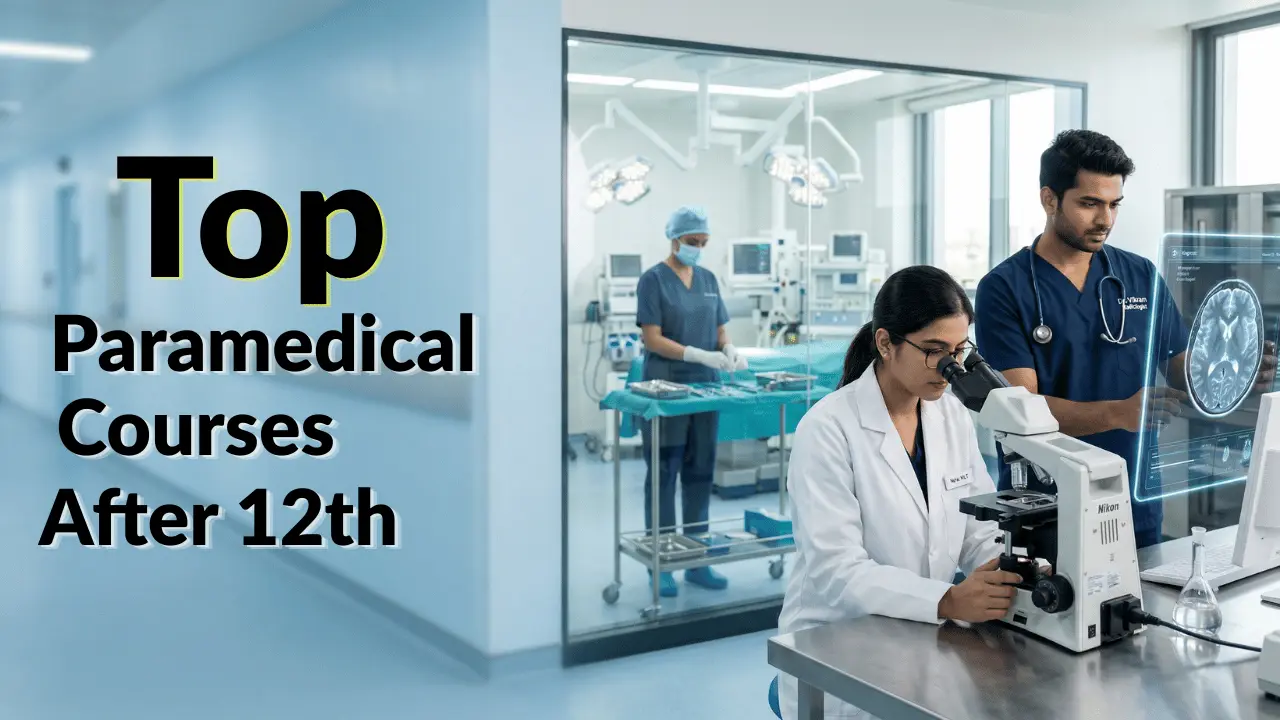
The healthcare world does not wait. Right now, in April 2026, thousands of 12th-grade students across India are finishing their board exams and staring at a question that matters more than any paper they just wrote: what comes next? If you have a science background and want a real, stable, rewarding career in healthcare without the brutal NEET grind, the top paramedical courses after 12th deserve your full attention today.
Why Paramedical is No Longer the “Second Choice”
For years, allied healthcare was treated as a backup plan. That thinking is outdated. In 2026, corporate hospital chains, diagnostic networks, and tier-2 city healthcare facilities are actively competing for skilled paramedical graduates. The talent gap is real, and it works in your favor.
Unlike an MBBS degree that takes over half a decade, paramedical programs get you into the workforce in 2 to 4 years. You start earning sooner, build clinical experience faster, and step into roles that directly impact patient lives from day one.

Technology has also transformed these careers. Radiographers now work alongside AI diagnostic software. Operation theatre technicians assist in robotic-assisted surgeries. Lab analysts use advanced automated pathology systems. This is not your older sibling’s paramedical field.
The Regulatory Shift You Must Know About in 2026
Before diving into specific courses, one important update: the National Commission for Allied and Healthcare Professions (NCAHP) has significantly tightened its registry requirements in recent years.
If you plan to practice professionally in India, your degree or diploma must come from an institution recognized under the NCAHP framework. This protects your career long-term and ensures your qualification is valid for government jobs, private hospitals, and international recruitment. Always verify NCAHP accreditation before enrolling anywhere.
Top Paramedical Courses After 12th: Degree Programs That Offer the Best Growth
When it comes to career ceiling and starting salary, full undergraduate degree programs are the strongest foundation.
Bachelor of Physiotherapy (BPT) stands at the top of the list. This 4.5-year program covers human anatomy, biomechanics, and physical rehabilitation in serious depth. With sedentary work culture and sports participation both rising simultaneously, physiotherapists are in demand across corporate wellness programs, sports teams, orthopaedic clinics, and private practice. Starting salaries range from Rs 3.5 LPA to Rs 6 LPA, with significant upside as you specialize.
B.Sc. in Medical Radiology and Imaging Technology (BMRIT) is arguably the most technology-forward choice right now. You will be trained to operate MRI, CT, PET, and X-ray equipment, plus work with AI-assisted diagnostic tools. Teleradiology is a booming sub-sector that even allows remote work arrangements. Expect starting pay between Rs 3.5 LPA and Rs 5.5 LPA.
B.Sc. in Medical Laboratory Technology (BMLT) puts you at the diagnostic center of modern medicine. Doctors rely entirely on lab results to make treatment decisions. BMLT graduates analyze blood, tissues, and body fluids, and work across pathology labs, blood banks, research facilities, and public health organizations. The 3-year program offers solid job security with entry-level salaries from Rs 3 LPA to Rs 5 LPA.
B.Sc. in Operation Theatre Technology (BOTT) is a high-stakes, high-responsibility role that most students overlook. OT technicians ensure sterile surgical environments, manage equipment calibration, and directly assist during complex procedures. If you thrive under pressure and want to be inside the action, this 3-year program is worth serious consideration.
Bachelor of Optometry (B.Optom) has seen a quiet surge in demand. Screen time in 2026 is at historic highs, and vision disorders are increasingly common across all age groups. Optometrists are needed in eye hospitals, optical retail chains, and standalone vision clinics, with starting salaries between Rs 3 LPA and Rs 4.5 LPA.
B.Sc. Nursing, while technically its own stream, deserves a mention here. The 4-year program remains one of the highest-demand allied health qualifications globally, with starting salaries matching physiotherapy at Rs 3.5 LPA to Rs 6 LPA.
Fast-Track Diploma Options for Top Paramedical Courses After 12th
If entering the workforce quickly is your priority, diploma programs deliver focused, job-ready training in 1 to 2 years.
The Diploma in Medical Laboratory Technology (DMLT) is the most popular choice. It covers core pathology and diagnostic testing, and graduates are absorbed quickly into the rapidly expanding network of private diagnostic centers.
The Diploma in Dialysis Technology is a niche but powerful pick. Chronic kidney disease is a growing public health crisis in India, and trained dialysis technicians are in short supply. This specialization comes with strong job security.
The Diploma in Emergency Medical Technician (EMT) prepares you for frontline trauma care, ambulance services, and critical response. With the expansion of private ambulance networks and hospital emergency departments, EMTs are no longer just a government-sector role.
Diploma holders can expect starting salaries between Rs 2.5 LPA and Rs 4 LPA, with room to grow through experience and additional certifications.

2026 Entrance Exam Windows: Do Not Miss These Dates
Since you are reading this in April 2026, timing matters. Most state-level paramedical Common Entrance Tests (CET) are scheduled between May and July 2026. The AIIMS Paramedical entrance exam typically opens its application window in May, with exams conducted in June. Several central universities accepting CUET scores have already opened or are about to open their paramedical program applications for the 2026-27 academic session.
Check your target state’s health sciences university website immediately. Application windows for government colleges, which offer the best value and NCAHP-recognized seats, fill fast.
Basic Eligibility at a Glance
Most degree programs require 10+2 with Physics, Chemistry, and Biology (PCB) and a minimum aggregate of 45 to 50 percent in core science subjects. Some programs like Optometry or Hospital Management also accept students from other streams.
Private universities generally offer merit-based direct admission. Government colleges require state CET scores or CUET results. Always confirm NCAHP accreditation status before paying any fees.
Who Should Seriously Consider Top Paramedical Courses After 12th
This path makes strong sense for you if you want job security in a field that genuinely cannot be automated away, you prefer hands-on clinical work over years of classroom theory, you want to start building real income before you turn 22, or you are interested in healthcare but prefer not to take the NEET route.
It also works well for students who have a specific interest in technology, diagnostics, or physical rehabilitation but have not found a clear fit in traditional engineering or pure science streams.
Salary Growth After the First Few Years
Entry-level numbers are just the starting point. Paramedical professionals who upskill into areas like nuclear medicine, neuro-rehabilitation, or advanced imaging typically see their salaries scale significantly within 3 to 5 years. International recruitment, particularly to Gulf countries, the UK, and Canada, is also active for experienced Indian paramedical graduates holding NCAHP-registered qualifications.
Final Word on Choosing the Right Path
The top paramedical courses after 12th offer something rare in today’s job market: a direct, clear connection between what you study and what you do for work. There is no ambiguity. You train for a specific clinical role, you qualify, and you contribute immediately.
Evaluate honestly where your interests sit. If you are drawn to precision and technology, radiology or lab technology fits well. If you want physical, patient-facing work, physiotherapy is hard to beat. If you want to be at the center of surgical action, operation theatre technology is your arena.
Whatever you choose, make sure the institution is NCAHP-recognized, the placement record is verifiable, and you are applying before your state’s 2026 entrance exam window closes.
The healthcare sector is one of the few industries that grows regardless of economic cycles. A well-chosen paramedical qualification is not just a career, it is a foundation that keeps building value over time.
Which paramedical specialization are you leaning toward, and what is the biggest factor driving that decision for you?