
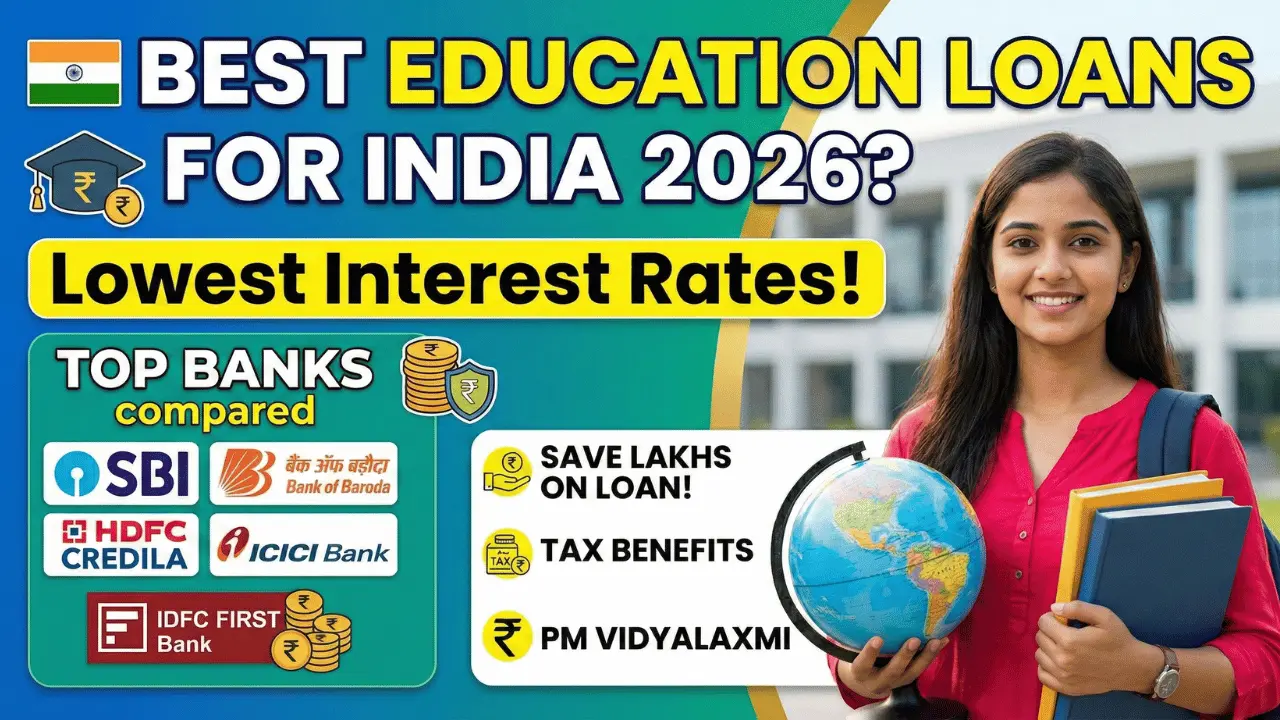
Higher education costs are rising every year, and for most Indian families, an education loan is no longer just an option. It has become a necessity. Whether you are planning to study at an IIT in India or heading abroad for a master’s degree, knowing how to pick the best education loan in India 2026 can save you lakhs of rupees in the long run.
This guide breaks everything down simply. You will find the latest interest rates, a clear bank comparison, and tips that most students never hear from their loan officer.
What is an Education Loan and How Does It Work?
An education loan is money you borrow from a bank or financial institution to cover your college fees, hostel charges, and living expenses. Once you graduate and start earning, you repay it in monthly installments called EMIs.
Before picking any bank, you should know there are two basic types of education loans available in India right now.

Secured vs. Unsecured: Which Type Do You Need?
Secured Education Loan (With Collateral): You pledge an asset like a house, land, or fixed deposit. Because the bank has a backup, they offer lower interest rates and higher amounts, sometimes up to Rs. 1.5 Crore or more.
Unsecured Education Loan (Without Collateral): No property is pledged. The bank evaluates your marks, your college reputation, and your parents’ income. Rates are slightly higher and loan caps are usually around Rs. 40 to 50 Lakhs.
Choosing between the two depends on your family’s financial situation and how urgently you need the funds.
Best Education Loan in India 2026: Top Banks Compared
Let us look at the banks that are actually offering the lowest interest rates and the best terms this year.
SBI Education Loan
State Bank of India remains the most trusted name for student loans in India. With government backing and no hidden charges, SBI consistently offers some of the most competitive rates.
For students admitted to top premier institutes like IITs and IIMs, the SBI Scholar Loan interest rate can start as low as 7.05% per annum, making it the lowest available anywhere in the country right now. For students going abroad, the SBI Global Ed-Vantage scheme offers rates between 10.45% to 10.90% p.a. with a maximum loan of Rs. 1.5 Crore. Female students also get a flat 0.50% discount on the interest rate across all schemes.
Bank of Baroda Education Loan
Bank of Baroda’s “Baroda Scholar” scheme is widely respected, especially for students heading to foreign universities. Interest rates start around 9.20% p.a. and they offer up to Rs. 1.25 Crore for medical and aviation courses abroad.
One of their biggest advantages is 100% financing for top global universities, which means you do not have to arrange any margin money from your own pocket.
Punjab National Bank Education Loan
PNB’s “Udaan” scheme for international studies and “Pratibha” scheme for premier Indian institutes are both solid options. Interest rates start from around 9.15% p.a. for premier institutes.
PNB also gives a concession for female students, and their loan amounts are need-based, meaning there is no strict upper cap if you have proper collateral.
HDFC Credila Education Loan
HDFC Credila is a dedicated education financing company and one of the fastest lenders in the market. If you need approval before your visa arrives, Credila is one of the very few lenders who will do it.
Interest rates start from 9.95% p.a. and they fund living expenses more generously than most banks. Their doorstep service also makes the documentation process far less painful.
ICICI Bank Education Loan
ICICI Bank offers flexible terms and fast digital processing, particularly useful if you already bank with them. Secured loan rates start around 9.00% p.a. while unsecured loans begin at 10.25% p.a.
📋 Latest Updates

For high-value loans, ICICI offers up to Rs. 3 Crore with collateral and up to Rs. 1 Crore without collateral for students admitted to top global universities.
IDFC First Bank Education Loan
If you do not want to pledge your parents’ property, IDFC First Bank is one of the strongest options right now. They offer up to Rs. 1 Crore collateral-free, which is among the highest in this category.
Rates start around 9.50% p.a. and they provide 100% financing with no margin money requirement for students at top universities.
Quick Interest Rate Comparison Table 2026
| Bank / Lender | Starting Rate (Approx.) | Max Loan Amount | Best For |
|---|---|---|---|
| SBI (Premier Institutes) | 7.05% p.a. | Up to Rs. 1.5 Cr+ | Lowest rates, IIT/IIM students |
| Punjab National Bank | 9.15% p.a. | Need-based | Premier Indian institutes |
| ICICI Bank | 9.00% p.a. | Up to Rs. 3 Crore | Fast processing, large amounts |
| Bank of Baroda | 9.20% p.a. | Up to Rs. 1.25 Crore | Study abroad, medical courses |
| IDFC First Bank | 9.50% p.a. | Up to Rs. 1 Crore (Unsecured) | High collateral-free loans |
| Avanse NBFC | 9.50% p.a. | Up to Rs. 1.25 Crore | Flexible approvals |
| HDFC Credila | 9.95% p.a. | Unlimited (profile-based) | Pre-visa, doorstep service |
Rates are indicative for early 2026 and may vary based on RBI guidelines and your profile. Always confirm with the bank before applying.
PM Vidyalaxmi Scheme: The Government Option You Cannot Ignore
One of the biggest developments for education financing in India is the PM Vidyalaxmi Scheme, a central government initiative designed to make higher education accessible to every deserving student regardless of their family’s financial situation.
Under this scheme, students admitted to quality higher education institutions can access loans with subsidized interest rates ranging from approximately 6.85% to 9.45% p.a., depending on the institution tier and the student’s family income. The government directly provides an interest subsidy, meaning you pay significantly less during your study years.
This scheme is particularly valuable for students from middle-income families who often do not qualify for full scholarships but still find regular loan interest rates difficult to manage. If your college is recognized under this scheme, applying through it before going to a private lender is a smart first step.
5 Key Terms You Must Understand Before Signing Any Loan
Walking into a bank without knowing these terms is like signing a contract blindfolded. Let us decode them clearly.
Moratorium Period
This is the “no repayment” period the bank gives you while you are studying. It usually covers your entire course duration plus 6 to 12 months extra for job placement. Full EMIs only begin after this period ends.
Simple vs. Compound Interest During Study Years
Even during the moratorium, interest keeps building on your loan. Some banks charge simple interest during this period, which is far better for your finances in the long run. If your family can pay just the interest amount while you study, you can save a significant amount when repayment begins.
Co-Applicant
Since students do not have a salary, banks require a co-applicant, usually a parent or guardian, who takes joint responsibility for the loan. The co-applicant’s income, employment stability, and CIBIL score (ideally above 750) play a major role in getting your loan approved at the best rate.
Margin Money
Most banks do not fund 100% of your college expenses. They typically cover 85% to 95%, and you must arrange the remaining 5% to 15% yourself. This is called margin money. Some banks waive it entirely for students admitted to top-ranked global universities.
Fixed vs. Floating Interest Rate
A fixed rate stays the same throughout your repayment. A floating rate moves with the RBI’s policy changes. Most Indian education loans today are on floating rates, which can work in your favor when the RBI cuts rates.

Section 80E Tax Benefit: Save More While Repaying
Here is a benefit that thousands of loan borrowers miss completely. Under Section 80E of the Income Tax Act, the entire interest amount you pay on an education loan in a financial year is fully deductible from your taxable income.
There is no upper limit on this deduction, and you can claim it for up to 8 consecutive years from the year you start repaying. This means both students who start earning and parents paying on behalf of their children can benefit significantly from this provision.
Eligibility Checklist: What Do Banks Actually Look For?
To get the best education loan in India 2026, you need to meet these basic conditions.
You must be an Indian citizen, usually between 18 and 35 years old. You need a confirmed admission letter from a recognized institution in India or abroad. A co-applicant with stable income and a good credit history is mandatory. Your own academic record across 10th, 12th, and any previous degrees also matters, as banks take grades seriously when assessing your future repayment capacity.
Documents you will need: Admission letter and official college fee structure, KYC documents for both student and co-applicant (Aadhaar, PAN, Passport), co-applicant’s 3 months salary slips, 6 months bank statements, Form 16, and 2 to 3 years of IT returns, and property documents if you are going for a secured loan.
Smart Tips to Get the Lowest Rate Possible
Most students accept the first rate the bank offers. But there is real room to negotiate if you know these tricks.
Check if your college is on the Premier List. Every bank maintains a list of top-ranked institutions. If your college is on it, you automatically qualify for lower rates and often get the collateral requirement waived. This alone can save you 1% to 2% on your interest rate.
Apply as a female student or with a female co-applicant. Almost all public sector banks in India offer a 0.50% concession for female students, which adds up to a meaningful saving over a 10-year repayment.
Work on the co-applicant’s CIBIL score first. If your co-applicant has a score above 800 and no existing loans, you have genuine bargaining power with private banks and NBFCs. You can request a lower rate before signing.
Consider loan insurance. Banks like SBI offer insurance products mapped to your loan amount. Agreeing to purchase one sometimes gives you leverage to negotiate a marginally better rate.
Which Bank Should You Actually Choose?
There is no single answer because the best option depends entirely on your situation.
Go with SBI or Bank of Baroda if you want the absolute lowest rates, are not in a rush (government banks take 15 to 30 days to process), and are comfortable pledging a property as collateral.
Go with HDFC Credila or Avanse if you need fast approval, want generous living expense coverage, and prefer doorstep service over visiting a branch multiple times.
Go with IDFC First Bank or ICICI Bank if you are heading to a top global university and want a large loan without putting your parents’ property at risk.
And if your institution qualifies, always check the PM Vidyalaxmi Scheme first, because subsidized government rates will almost always beat what any private lender can offer.
The best education loan in India 2026 is not the one with the prettiest brochure. It is the one that fits your college tier, your family’s financial strength, and your repayment timeline perfectly. Take your time, compare at least three lenders, and make sure you read the fine print before signing anything.
