
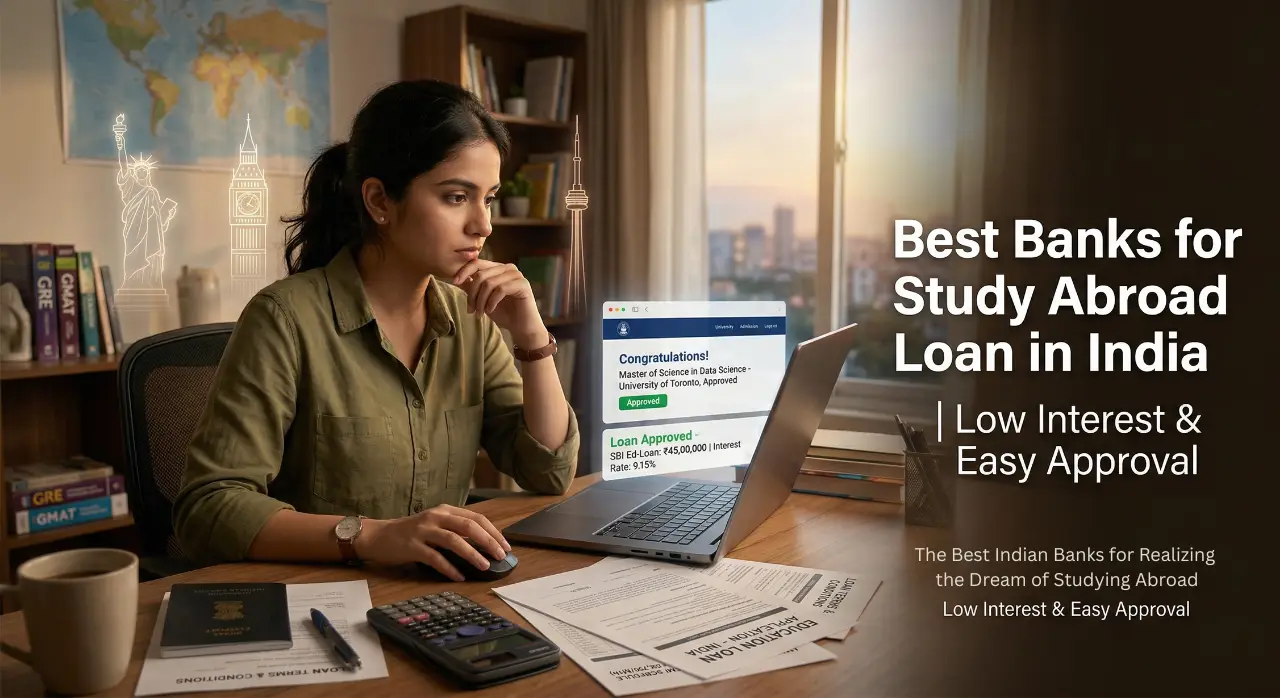
Every year, thousands of Indian students finalize their dream university admits, then spend the next three months scrambling to figure out how to actually pay for it. Tuition fees in the US, UK, Canada, and Germany have never been higher, and the rupee’s purchasing power abroad makes it even more daunting. Choosing the right lender from the best banks for study abroad loan in India is not just a financial decision — it is a decision that will follow you for the next 15 years of your life. Get it right, and you save lakhs. Get it wrong, and you spend your early career paying a price that was entirely avoidable.
This guide breaks down the top lenders for 2026, their real interest rates, EMI impact, hidden costs, and a few financial rules that most students only discover after signing the dotted line.
Why Your Choice of Lender Matters More Than You Think
A 1% difference in interest rate on a Rs. 50 Lakh loan over 15 years does not translate to a minor inconvenience. It translates to roughly Rs. 10 Lakhs in extra repayment. On a Rs. 1 Crore loan, that gap widens dramatically.
Beyond the interest rate, there are processing fees, collateral requirements, co-applicant income conditions, and a critical government tax rule that most loan guides conveniently skip. All of it adds up to a picture that is much more nuanced than a simple rate comparison table.
The good news is that Indian banks and NBFCs (Non-Banking Financial Companies) have become significantly more student-friendly in 2026, with faster processing, flexible documentation, and genuinely competitive products.

Complete Guide to Hotel Jobs Abroad Without Degree in 2026 (Updated for Peak Hiring Season)
Top Lenders: Best Banks for Study Abroad Loan in India at a Glance
Before diving deep, here is a quick snapshot of the leading options available right now.
State Bank of India (SBI) continues to lead on interest rates, offering secured education loans starting from 8.40% and going up to around 10.15% depending on the product and collateral. It also provides a 0.50% concession specifically for female applicants, which makes it one of the most cost-effective choices available. Loan amounts can go up to Rs. 1.5 Crore to Rs. 3 Crore with property or fixed deposits as collateral.
Bank of Baroda runs a tiered structure under its Baroda Scholar Scheme. Students admitted to globally ranked premier institutions get access to rates starting at 8.70%, while non-premier university admits see rates that can go up to 12.70%. BoB also offers a 0.20% concession for female students on non-premier categories. Secured loans for top-ranked universities can reach up to Rs. 1.5 Crore.
HDFC Credila is the go-to name for students who lack tangible collateral but carry a strong academic profile. Floating rates start from around 9.75% on the secured side and climb to 10.75% to 11.25% for unsecured loans. For US-bound students with GRE scores above 300 and solid co-applicant financials, Credila can sanction unsecured loans up to Rs. 75 to 80 Lakhs. They also provide pre-admission sanctions, which can actually strengthen a university application.
Avanse Financial Services is built for speed. If an I-20 deadline or a Canadian study permit timeline is creating pressure, Avanse can often get approvals done within a week. Interest rates range from 10.00% to 16.50% depending on credit profile and the university in question. Their unsecured loan limits for strong applicant profiles can reach up to Rs. 1.25 Crore.
The TCS Rule: Why Borrowing From a Formal Bank Saves You Money on Day One
Here is the financial reality that almost no loan guide mentions clearly, and it is worth understanding before you finalize anything.
Under the Liberalised Remittance Scheme (LRS), when you remit money abroad for education above Rs. 7 Lakhs in a financial year, Tax Collected at Source (TCS) kicks in. The rate depends entirely on where the money is coming from.
📋 Latest Updates



If the remittance is funded by an education loan from a recognized financial institution — a bank or a registered NBFC — the TCS rate above Rs. 7 Lakhs is just 0.5%. However, if you fund the remittance from personal savings or through an informal or non-approved source, the TCS rate for education jumps to 5%.
On a Rs. 50 Lakh remittance, that difference is roughly Rs. 2.15 Lakhs in upfront tax outgo. Yes, TCS is ultimately adjustable against your tax liability, but for a student who is not earning yet, recovering that capital takes time. Taking a formal bank loan essentially locks you into the 0.5% TCS bracket and keeps your upfront cash outgo significantly lower.
Processing Fees and Hidden Costs: The Full Picture
Interest rates get all the attention, but processing fees can quietly add a meaningful chunk to the total cost of your loan, especially on large amounts.
SBI for its Global Ed-Vantage scheme charges a flat processing fee in the range of Rs. 10,000 plus applicable GST. For a Rs. 1 Crore loan, this is a very manageable and transparent cost. Bank of Baroda follows a similar structure for public sector borrowers.
HDFC Credila, by contrast, charges 1% to 1.25% of the total loan amount as a processing fee. On a Rs. 50 Lakh loan, that is Rs. 50,000 to Rs. 62,500 upfront, before a single EMI is paid. Avanse has similar percentage-based processing charges that vary by profile.
This does not make NBFCs a bad choice — their speed, flexibility, and willingness to work with unsecured profiles is genuinely valuable. But the comparison needs to be made on the total cost of borrowing, not just the headline interest rate.
EMI Reality Check: What Will You Actually Pay?
Most study abroad loans come with a moratorium period — usually the course duration plus 6 to 12 months. During this window, you are typically required to pay only simple interest, not full EMIs. The full repayment clock starts after you graduate and find employment.
Here is what a Rs. 50 Lakh loan looks like over a 15-year repayment period once the moratorium ends, at three different rate scenarios.
At SBI’s rate of around 8.90%, the monthly EMI works out to approximately Rs. 50,200. Total interest paid over 15 years is roughly Rs. 40.3 Lakhs, making total repayment around Rs. 90.3 Lakhs.
At HDFC Credila’s rate of around 10.75%, the monthly EMI rises to approximately Rs. 55,800. Total interest grows to around Rs. 50.5 Lakhs, pushing total repayment to close to Rs. 1 Crore.
At Avanse’s midpoint rate of around 12.00%, the monthly EMI climbs to approximately Rs. 60,000. Total interest over the tenure reaches around Rs. 58 Lakhs, with total repayment crossing Rs. 1.08 Crore.
The gap between the cheapest and the most expensive option on this Rs. 50 Lakh example is nearly Rs. 18 Lakhs over the life of the loan. At Rs. 1 Crore, that gap roughly doubles.

Complete Guide to Study + Work in Canada: What Every International Student Must Know in 2026
Co-applicant Requirements: Public Banks vs NBFCs
This is another dimension that significantly affects who should apply where, and it is something most borrowers discover mid-process.
Public sector banks like SBI and Bank of Baroda place the bulk of their credit analysis on the quality of the collateral offered — the property value, fixed deposits, or other tangible assets. The co-applicant (usually a parent or guardian) is required, but the CIBIL score and income profile of the co-applicant carry less weight when strong collateral is present.
NBFCs like HDFC Credila and Avanse function very differently. Since many of their popular products involve unsecured loans (no property pledge), they rely heavily on the co-applicant’s financial strength. This means the co-applicant’s income tax returns, credit score, employer profile, and monthly income all come under close scrutiny. A strong co-applicant with a clean CIBIL score above 750 and consistent ITR filings can unlock significantly better rates and higher unsecured limits at these lenders.
Understanding this distinction upfront helps you approach the right lender for your specific situation, rather than wasting time gathering documentation for a product you were never going to qualify for.
Tax Benefit on Education Loans: Section 80E
This is the part of education loan planning that even financially aware families sometimes miss. Under Section 80E of the Income Tax Act, the entire interest component paid on your education loan is tax-deductible — with no upper cap on the deduction amount.
This benefit is available for up to 8 consecutive financial years from the year you begin repaying the loan. What this means in practice is that the effective cost of borrowing is meaningfully lower than the stated interest rate, especially in the early years when interest payments are high. It effectively makes an already-competitive loan even more affordable once you are earning and filing taxes.
Best Banks for Study Abroad Loan in India: Who Should Choose What
If you have tangible collateral in the form of property or fixed deposits and are targeting a globally recognized university, SBI and Bank of Baroda are the clear front-runners. Their rates are the lowest in the market, the processing fees are fixed and transparent, and the repayment terms are student-friendly.
If your academic profile is strong — high GRE score, admission to a ranked institution, a co-applicant with solid income and credit history — but you do not have property to pledge, HDFC Credila is the most credible private option. Yes, the rate is higher, but the access to large unsecured amounts and the pre-admission sanction capability make it genuinely useful.
If time is the constraint — visa appointments, enrollment deadlines, blocked account requirements — Avanse is the fastest option available. The rate premium is real, but so is their ability to get things done when others cannot.
The Smart Play: Apply to Two Lenders Simultaneously
One practical move that many students overlook is applying to both a public sector bank and a private NBFC at the same time. The competing approval letters give you negotiating leverage, particularly on processing fees and ancillary charges. More importantly, they give you a fallback if one lender hits a snag — which happens more often than banks will publicly admit.
Start your public bank application first since it takes longer, and initiate the NBFC application a week later. By the time both are in review, you will have a much clearer picture of your options without having lost any time.
Conclusion
Financing an international education in 2026 is complex, but it is entirely manageable if you understand the full landscape. The best banks for study abroad loan in India offer genuinely competitive products — the difference lies in the details: collateral versus co-applicant income, flat fees versus percentage-based charges, and the 0.5% TCS advantage that comes with borrowing from a recognized institution.
Do the full math before you commit. Not just the headline rate, but the total repayment, the upfront fees, the TCS savings, and the Section 80E benefit over 8 years. A loan that looks slightly more expensive on paper can sometimes cost less in practice.
Which lender are you leaning toward for your study abroad plans, and what has been the biggest challenge in the application process so far?
