
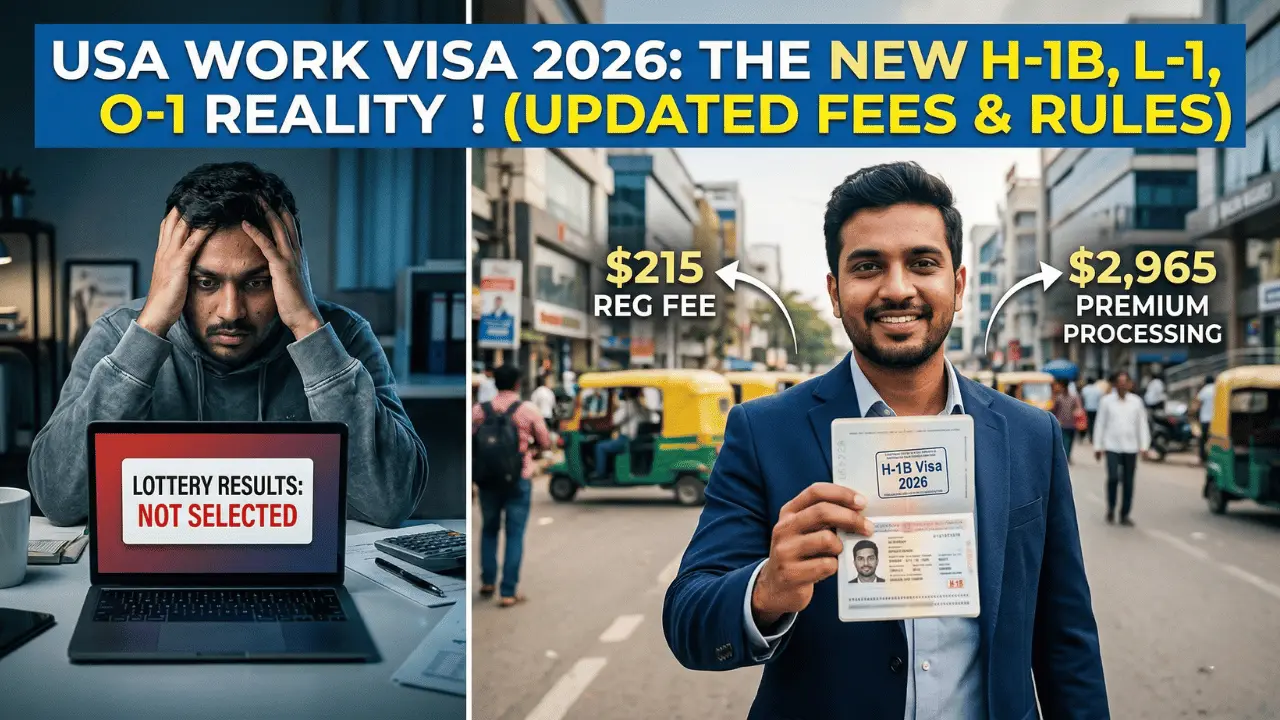
Every year, thousands of Indian professionals stare at their screens, refreshing their email, waiting to find out if they made it through the H-1B lottery. The work visa process for USA applicants from India has never been a simple road, but 2026 has introduced a fresh wave of fee hikes, new form requirements, and a fundamentally different lottery system that every applicant and their employer needs to understand before they make a single move.
Why 2026 is a Turning Point for Indian Work Visa Applicants
The U.S. immigration landscape has shifted considerably in early 2026. New fee structures, stricter compliance requirements, and a more deliberate selection process mean that the old playbook no longer works.
If you are an Indian professional eyeing a U.S. work visa, the decisions your employer makes in the next few months will directly shape your outcome. This guide breaks down exactly what has changed, what it costs, and how to position yourself for the best possible result.
Choosing the Right Visa Category Before Anything Else
Before diving into paperwork, you need to land on the right visa type. The three most relevant categories for Indian professionals are the H-1B, L-1, and O-1.
The H-1B is the most common path for Indian IT professionals and skilled workers. It requires a bachelor’s degree or its equivalent, a job offer in a specialty occupation, and the ability to survive a competitive lottery. The L-1 visa works differently. It is designed for employees of multinational companies transferring from an Indian office to a U.S. branch. L-1A covers managers and executives, while L-1B is for specialized knowledge workers. There is no lottery involved here, which makes it a significantly less stressful route for those who qualify.
The O-1 visa is for individuals with a proven track record of extraordinary achievement in their field. It demands detailed documentation, but it completely sidesteps the lottery system. If your career accomplishments are strong enough to support an O-1 petition, it is worth a serious conversation with an immigration attorney.
Step-by-Step Work Visa Process for USA Applicants from India
Understanding the full process from start to finish helps reduce surprises and avoids costly mistakes.
Employer Files Form I-129
The entire process starts with your U.S. employer. They must file Form I-129, the Petition for a Nonimmigrant Worker, with USCIS. There is a critical update here. As of April 1, 2026, USCIS only accepts the newest version of Form I-129. Any employer submitting an older version faces an automatic rejection, no exceptions. Employers must double-check they are using the correct edition before filing.
For H-1B petitions, this step happens only after the candidate is selected in the lottery. For L-1 and O-1 petitions, the employer can file directly once the paperwork is ready.
USCIS Reviews and Decides
Standard processing can take several months. Employers who need a faster decision can pay for Premium Processing, which guarantees a decision or a Request for Evidence within 15 calendar days. More on the cost of this shortly.
DS-160 Form and Consular Appointment
Once USCIS approves the I-129, you complete the DS-160, the Online Nonimmigrant Visa Application, and pay the visa application fee. You then schedule two appointments at a U.S. Embassy or Consulate in India, which includes New Delhi, Mumbai, Chennai, Hyderabad, or Kolkata.
The first appointment is at a Visa Application Center for biometrics. The second is the consular interview, where an officer verifies your qualifications, the legitimacy of your job offer, and your intentions.
Passport Stamping and Travel
If the interview goes well, the consulate retains your passport for visa stamping. Once it is returned, you are cleared to travel to the United States.
The New Lottery Reality: Wage-Based Selection is Now Being Fully Enforced
This is arguably the most important shift for the FY 2027 H-1B cycle. While a wage-based weighted selection system was introduced in previous years, this is the first season where it is being fully scrutinized and applied rigorously.
Under this system, petitions offering higher wage levels, specifically Level III and Level IV on the Department of Labor wage scale, receive more entries in the lottery compared to lower-wage petitions. This fundamentally changes the strategy for employers and applicants alike.
If your job offer places you in a lower wage band, your statistical chances are meaningfully reduced compared to higher-paid candidates. Applicants need to understand their O*NET occupation code and exactly where their offered salary sits on the prevailing wage scale. Working with your employer to maximize your wage level is no longer just good practice. In 2026, it is a competitive necessity.
2026 Fee Updates Every Applicant Must Know
The cost of filing a U.S. work visa petition has risen substantially. The numbers your employer is working with are as follows.
The H-1B lottery registration fee for the FY 2027 cycle jumped to $215 per beneficiary. The base filing fee for Form I-129 is now $780, or $460 for smaller organizations. On top of that, a new Asylum Program Fee of $600 applies to most I-129 petitions, reduced to $300 for employers with 25 or fewer employees, and waived entirely for non-profits.
The ACWIA Training Fee runs either $750 or $1,500 depending on the size of the employer. The Fraud Prevention and Detection Fee adds another $500 for initial H-1B or L-1 petitions or those involving a change of employer.
Premium Processing, effective March 1, 2026, now costs $2,965, up from the previous $2,805. A new Visa Integrity Fee of $250 applies at the time of visa issuance across nearly all nonimmigrant categories.
For the applicant personally, the DS-160 visa application fee is $205, and the $250 Visa Integrity Fee is typically an out-of-pocket cost at the consulate.
The $100,000 Offshore Fee: What Applicants Need to Know Right Now
There is a lot of noise around a proposed $100,000 additional fee targeting employers filing new H-1B petitions for workers currently located outside the United States. This proposal stems from a 2025 presidential proclamation and would hit Indian applicants especially hard.
As of April 2026, this measure is still caught up in federal litigation and has not been enforced by USCIS. Employers should not pay this fee unless USCIS formally mandates it. However, the situation should be monitored closely because a court ruling could change the picture quickly.
Who Pays What: Protecting Yourself from Fraud
U.S. law is clear on this. The employer is legally required to cover the I-129 base filing fee, the Asylum Program Fee, the ACWIA Training Fee, and the Fraud Prevention Fee. These costs cannot be passed on to the worker.
If any agency or supposed employer in the United States asks you to personally pay any of these employer-mandated fees, that is a direct violation of U.S. labor law and a serious red flag for fraud. Walk away and report it.
The fees that do land on the applicant or can be shared include the DS-160 visa fee, Premium Processing if agreed upon, and the Visa Integrity Fee.
Practical Tips for Navigating the Work Visa Process for USA in 2026
Book your consular interview appointment the moment your I-129 is approved. Wait times at U.S. Consulates in India have stabilized compared to the post-pandemic backlog, but they can still stretch out depending on the location and time of year.
If you are already in the United States on another visa status and planning to change status, do not travel internationally while your petition is pending without speaking to an immigration attorney first. Leaving the country at the wrong moment can jeopardize your entire case.
Make sure your employer is filing the correct April 2026 version of Form I-129. An auto-rejection due to a form version error wastes months of planning and money on fees that are generally non-refundable.
Finally, work with a qualified immigration attorney. With the fee landscape changing, new form requirements active, and a wage-weighted lottery fully in play, the stakes for errors have never been higher.
The Real Cost of a U.S. Work Visa in 2026
When you add up the H-1B registration fee, the base I-129 fee, the Asylum Program Fee, the ACWIA Training Fee, and the Fraud Prevention Fee, a standard H-1B petition now costs an employer anywhere between $2,845 and $3,595 in government fees alone, before Premium Processing is even considered. Add $2,965 for Premium Processing and the total can clear $6,500.
This is an expensive investment for any company. Understanding this reality helps you have a more informed and transparent conversation with your prospective employer about their willingness and ability to sponsor a petition.
Conclusion: The Work Visa Process for USA Demands Precision in 2026
The U.S. work visa process from India has never required more preparation, precision, and financial awareness than it does right now. Between the mandatory new Form I-129, the fully enforced wage-based lottery, climbing fees, and the litigation-clouded offshore fee proposal, both applicants and sponsors need to enter this process with their eyes wide open.
The fundamentals have not changed. You need a willing U.S. employer, a clean application, and a strategy that accounts for current USCIS priorities. What has changed is the level of detail and compliance required to get it right.
If you are serious about working in the United States, start the conversation with your employer today and make sure they are working with qualified immigration counsel.
Are you currently in the process of applying for a U.S. work visa, or is your employer just beginning to explore sponsorship options?